Victorian women's social and legal subordination
Poor ThingsVictorian women's social and legal subordination in Poor Things is not confined to a single statute or private relationship: it shapes women’s chances of surviving poverty, controlling their bodies, entering medical work, and retaining property. The narrative sets these constraints against women’s practical knowledge and the reforming ambitions of Godwin Baxter and Bella Baxter, showing how formal authority and unequal material conditions reinforce one another.
Social and Legal Conditions
Godwin Baxter describes the deaths of young women by drowning as a recurring consequence of poverty and social prejudice. He connects that vulnerability to the legal treatment of suicide: in the Christian nation he describes, a person who attempted it could be treated as insane or criminal, exposing women who had chosen death to further coercive confinement in madhouses, reformatories, or jails. His account makes the law’s response part of the danger rather than a neutral protection, since it offers punishment or institutional custody where the story identifies poverty and prejudice as underlying pressures.
Baxter also places women’s constrained lives beside the routine concealment of births judged impossible or unlikely to survive. He lists infants born without a brain or with multiple heads, cyclopean features, or no digestive tract; some could live only with artificial help, while others would die after birth unless someone intervened. Doctors and nurses, he says, were not permitted to order the killing of infants without digestive tracts, though the practice occurred. In Glasgow, which he identifies as Britain’s second-largest city and its foremost in infant mortality, many parents could not afford a coffin, funeral, and grave for each dead child. The account thus links reproductive suffering not only to social and religious judgment but also to inadequate resources and a medical system whose official rules did not eliminate the desperate practices those conditions produced.
Marriage law also appears as a barrier to women’s economic independence. After Bella Baxter and Archibald McCandless become engaged, Godwin Baxter notes that the British Parliament is debating a bill allowing married women to keep their own property. McCandless predicts that it will not become law, arguing that it would undermine marriage and that most members of Parliament are husbands. The exchange makes the issue concrete: Bella’s provision after Baxter’s death depends on a will, while the proposed reform would address the more basic question of whether a married woman could retain property in her own right.
Medical Authority and Women’s Work
The same exclusions that narrowed women’s legal and economic choices also governed who could practise medicine and whose knowledge counted. Godwin Baxter says that Britain has only four women doctors, all graduates of foreign universities. The Enabling Bill of 1876 and the work of Sophia Jex-Blake have helped open Dublin University to women, he explains, while Scottish universities are expected to follow. His proposed route for Bella Baxter is practical rather than merely academic: she would begin as a trainee nurse in an east Glasgow infirmary, prove herself under its discipline, and progress to assisting him as a theatre nurse before entering medical college. Baxter argues that doctors and surgeons should be trained through nursing or other manual work, challenging both the exclusion of women and the hierarchy that separates professional authority from hands-on care.
Bella’s ambitions extend this argument from access to the profession to the people medicine serves. Asked whom she wants to help, she names little girls, mothers, and prostitutes, and intends to teach women effective contraceptive methods. Baxter and Archibald McCandless advise her to keep that aim private until she can practise, and to wait before campaigning publicly; she agrees only when they acknowledge that the timing must remain her choice. The exchange exposes the limits of formal opportunity: medical training could give Bella a route to influence, but speaking openly about birth control could still bring scandal. Her intended work joins professional independence to women’s ability to make informed decisions about reproduction.
The unequal medical treatment of women is also visible in Bella’s conversation with Millie Cronquebil. Bella objects that inspections fall on the women working in the establishment even though, in her view, clients bring the diseases. She proposes training the women to examine each client before sexual contact, turning a one-sided inspection into a protective practice directed at those with greater power. The episode makes the question of medical authority concrete: women are subject to scrutiny, yet the system does not give them equal power to identify or prevent the danger.
A later dispute over clitoridectomy shows how medical language could recast women’s distress as a reason for bodily intervention. Dr. Prickett claims that Lady Blessington had begged for the operation because she hated her rages, her desire for contact with her husband, and her diseases; he says he postponed it until after childbirth. Godwin Baxter challenges the assumptions behind this account, linking the idea that women exist to produce men and that female sexual pleasure is sinful to ancient male thought and celibate Christian teaching. Bella shakes her head when Prickett addresses her as Lady Blessington and says she remembers none of it. The scene leaves the allegation in dispute, while making plain the stakes of a system in which a male doctor claims authority to interpret a woman’s sexuality and alter her body.
Reform, Backlash, and the Limits of Professional Authority
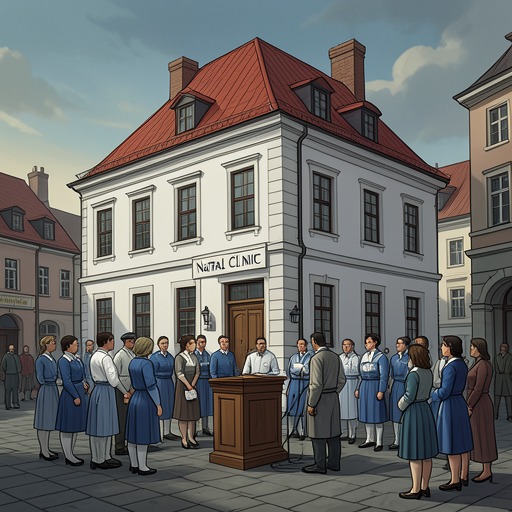
Victoria McCandless turned the prospect of medical training into sustained work. In 1886 she enrolled at the Sophia Jex-Blake School of Medicine for Women in Edinburgh, and in 1890 Glasgow University awarded her a Doctor of Medicine degree. That same year, she and Archibald McCandless opened the Godwin Baxter Natal Clinic in Dobbie’s Loan, near the Cowcaddens. The clinic was a charitable foundation, funded with all of Godwin Baxter’s money, and Victoria ran it with a small staff of local women whom she trained herself.
Her approach to staffing deliberately resisted the idea that competent care meant permanent dependence on a single medical authority. She did not keep a trained helper for more than a year: once an employee had learned what Victoria could teach, she urged her to leave and assist neighbours or work for a doctor who could teach her more. Some went on to enrol as nurses in city hospitals, though a ward sister complained that they asked too many questions. Their curiosity, presented as a professional liability by the hospital, also registered the clinic’s alternative ideal: women should acquire knowledge rather than simply submit to instruction.
Victoria carried that ideal into public health and childbirth. In 1899 the Fabian Society published her pamphlet Against Horizontalism, which challenged the routine of laying patients flat when, she argued, it made doctors feel stronger rather than serving patients. She accepted that bed rest was necessary for many illnesses but insisted that childbirth was not a disease and could proceed more easily in a squatting position, using birthing stools of the kind employed in the eighteenth century. She also treated horizontalism as a relation of authority: patients were expected to regard the body as a mystery understood only by doctors and to trust without question. Her proposed remedy began with education, including basic nursing in primary schools and medical training in secondary schools, so people could care for one another and recognize how unhealthy housing and working conditions damaged their communities.
Her reproductive politics brought opposition from different quarters. Clergymen across Christian churches denounced A Loving Economy for its birth-control proposals, while some birth-control advocates objected to Victoria’s warning that commercial contraceptives were unhealthy. She argued that they could narrow attention to genital sex and detach it from the ordinary affection and physical closeness she regarded as nourishing throughout life. The position resisted both religious condemnation of contraception and a commercial model that treated sexual pleasure as a rare commodity, but the resulting book received only two favourable notices, one from Guy Aldred in an anarchist periodical and another in The New Age.
The campaign against her clinic turned public hostility into institutional consequence. Beaverbrook expanded the circulation of the Daily Express through a campaign that sought to deprive Victoria of the clinic, and the newspaper published an article headed LADY DOCTOR ORDERS INCEST. At her trial, she maintained that she had taught nothing capable of harming mind or body. The Scottish jury returned a verdict of not proven: Victoria was not removed from the British medical register, but neither was she declared guiltless. The equivocal result preserved her professional status in law without shielding her from the accumulated pressure on her work.
By 1920, the clinic’s original managing committee, which had included Sir Patrick Geddes and Principal John Caird of Glasgow University, had been replaced by members less willing to withstand hostile publicity. They dismissed Victoria and transferred the clinic to Oakbank Hospital as an out-patients department. Having spent her savings printing, distributing, and advertising A Loving Economy, she was left with 18 Park Circus as her only property. She let its upper rooms to university students and withdrew to the basement, where she continued the Godwin Baxter Natal Clinic on a much smaller scale. The reduction did not erase her work, but it exposed the distance between gaining a medical qualification and retaining the institutional resources to practise on her own terms.
Narrative Authority and Women's Self-Definition
The book’s editorial frame makes the authority to describe women part of the problem it recounts. The editor says that Michael Donnelly lent him Archibald McCandless’s manuscript in 1990, believing it a lost masterpiece; in return for editorial control, the editor promised not to alter McCandless’s actual text, though he shortened the chapter headings and renamed the book Poor Things. He also moved Victoria McCandless’s letter from the proposed introduction to the epilogue, arguing that reading it first would prejudice readers against the main narrative. His explanation casts the letter as an attempt by a disturbed woman to conceal the truth of her origins, so Victoria’s own account reaches readers only after a male-authored story has already shaped their expectations.
The editor and Donnelly also disagree over whether McCandless’s account is fiction or history. The editor presents it as a loving portrait preserved by a friend and claims that archival research supports its factual basis; Donnelly, by contrast, considers historical material woven into a blackly humorous fiction. That dispute matters to the representation of women because Bella’s changing identity and Victoria’s later account are mediated through competing narrators rather than delivered as a single, uncontested record. Baxter’s comparison of the opening and final pages of Bella’s three-month diary likewise draws attention to change in a woman’s private writing, even as the available account leaves the diary’s contents unexplained. The frame thus exposes a recurring imbalance: women’s experiences become evidence in disputes over their identity, health, and credibility, while others retain substantial power to decide how those experiences will be read.